Awesome

Consider it

*/1b3f701f762c5777fab5995115fd53dae71219d6c602550dcc

Thursday, May 4, 2017

mortgage-rates-today-may-4-2017-plus-lock-recommendations


mortgage rates today

What’s Driving Mortgage Rates Today?


Mortgage rates today have edged up. (Many lenders raised rates late yesterday after the Fed meeting adjournment. Those that did not increase pricing yesterday will probably raise rates this morning.)


Today’s reporting didn’t do much to improve the situation. First, the Labor Department reported that US worker productivity fell by .6 percent last month.


Productivity is one of the few factors that is both good for both the economy and interest rates. An increase in productivity means more work getting done without a cost increase — good for the economy and also keeping inflation in check.


Unfortunately, we got a decrease in productivity, which has the opposite effect.


Click to see today’s rates (May 4th, 2017)


Jobs And Orders


Weekly Jobless Claims came in with 7,000 fewer than experts predicted — 238,000 versus 245,000. Fewer jobless claims is slightly positive for the economy and slightly bad for mortgage rates.


Finally, March’s Factory Orders also disappointed — up .2 percent instead of the expected .5 percent. This would be great for mortgage rates, but the report is pretty old, making it less important than last week’s (similar) Durable Goods Report.


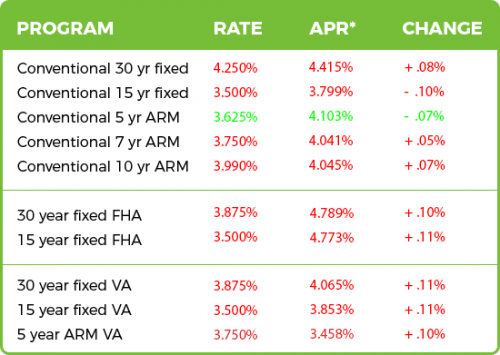
Mortgage Rates Today


current mortgage rates


Tomorrow


There should be plenty of mortgage-relates news stories. Five Fed members are speaking at various engagements today. Market participants will be listening.


The big deal, though, is what we get the first Friday of every month — the Jobs Report. When it varies from expectations, this report can rock the stock and bond markets and cause large mortgage rate changes.


Tomorrow’s report is expected to indicate that the unemployment rate remained at 4.5 percent, that average hourly earnings are up .3 percent, and non-farm payrolls increased almost 100,000 to 190,000.


If actual values indicate a stronger-than-expected economy, rates will rise. If unemployment rose or fewer jobs were created than anticipated, rates could fall.


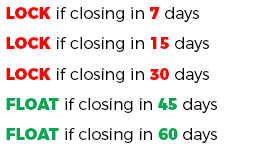
Rate Lock Recommendation


There’s risk of rising rates this week. The Fed is not expected to raise rates, but its post-meeting announcement might offer clues to a rate hike in June. Mortgage rates could rise if anything unexpected is found


rate lock recommendation


What Causes Rates To Rise And Fall?


Mortgage interest rates depend on a great deal on the expectations of investors. Good economic news tends to be bad for interest rates, because an active economy raises concerns about inflation. Inflation causes fixed-income investments like bonds to lose value, and that causes their yields (another way of saying interest rates) to increase.


For example, suppose that two years ago, you bought a $1,000 bond paying five percent interest ($50) each year. (This is called its “coupon rate.”) That’s a pretty good rate today, so lots of investors want to buy it from you. You sell your $1,000 bond for $1,200.


When Rates Fall


The buyer gets the same $50 a year in interest that you were getting. However, because he paid more for the bond, his interest rate is not five percent.


  • Your interest rate: $50 annual interest / $1,000 = 5.0%

  • Your buyer’s interest rate: $50 annual interest / $1,200 = 4.2%

The buyer gets an interest rate, or yield, of only 4.2 percent. And that’s why, when demand for bonds increases and bond prices go up, interest rates go down.


When Rates Rise


However, when the economy heats up, the potential for inflation makes bonds less appealing. With fewer people wanting to buy bonds, their prices decrease, and then interest rates go up.


Imagine that you have your $1,000 bond, but you can’t sell it for $1,000, because unemployment has dropped and stock prices are soaring. You end up getting $700. The buyer gets the same $50 a year in interest, but the yield looks like this:


  • $50 annual interest / $700 = 7.1% The buyer’s interest rate is now slightly more than seven percent.

Click to see today’s rates (May 4th, 2017)


The information contained on The Mortgage Reports website is for informational purposes only and is not an advertisement for products offered by Full Beaker. The views and opinions expressed herein are those of the author and do not reflect the policy or position of Full Beaker, its officers, parent, or affiliates.


mortgage-rates-today-may-4-2017-plus-lock-recommendations

Wednesday, May 3, 2017

federal-reserve-maintains-low-rates-no-hike-until-at-least-june


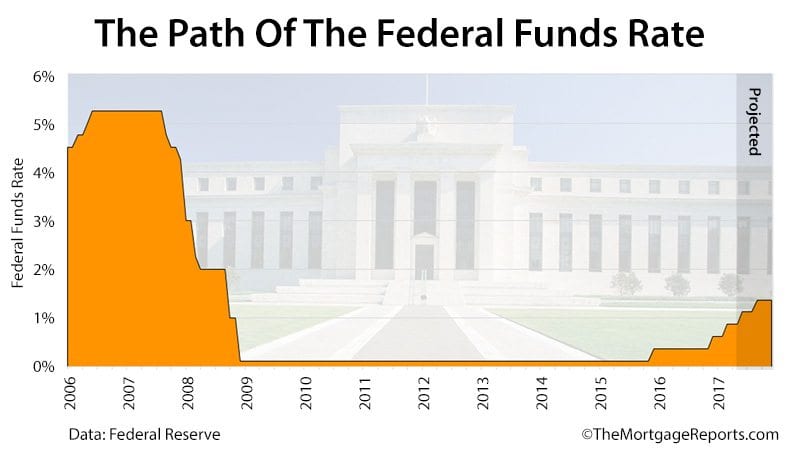
Federal Funds Rate Chart

Federal Reserve Maintains Low-Rate Policy


The Fed hit “pause” in May, keeping its benchmark rate unchanged.


The group cited labor market and inflation conditions that are still within expectations. Not too hot, but not too cold, either.


Interestingly, the post-meeting announcement addressed slowing economic activity, even as the economy in whole continues to strengthen.


The Fed could be leaving its options open for its June meeting. A hike is fully expected next month, but the Fed may be hinting that it’s not a sure thing.


That could be good for mortgage rates today.


Click to see today’s rates (May 3rd, 2017)


Fed: We’re Keeping Rates Low


Wednesday, the Federal Open Market Committee (FOMC) voted to maintain the Fed Funds Rate at a range between 0.75-1.00 percent.


That’s low by historical standards.


As recently as 2007, the federal funds rate topped 5%, meaning rates for credit cards, home equity lines of credit, and other consumer credit accounts were at least 400 basis points (4.00%) higher than they are today.


Mortgage rates were past 6%.


Seeking to maintain current growth, the Fed is keeping borrowing costs low across the board with its “no-hike” decision.


But the Fed is data-dependent, it reminded markets. The group’s future moves will depend on the strength of labor markets, and on the pace of inflation within the economy.


The Fed’s mandate is to balance those two forces.


Currently, labor markets are improving with job gains “solid” in recent months. The economy has now added more than 15 million jobs since 2010.


Job growth may ignite inflationary forces. Wages are ticking up. The Fed may need to increase rates to cool rising price increases within the economy.


The Fed aims at two percent inflation per year. Currently, inflation is running closer to 1.6%.


That could rise quickly, with the current on-fire stock market, rising oil prices, and unemployment at its lowest level since 2007.


The Fed used its statement to identify inflationary threats within the economy and to suggest the direction of future policy (emphasis added):


The Committee expects that economic conditions will evolve in a manner that will warrant gradual increases in the federal funds rate; the federal funds rate is likely to remain, for some time, below levels that are expected to prevail in the longer run. However, the actual path of the federal funds rate will depend on the economic outlook as informed by incoming data.


In plain English, this says that the Fed will raise the Fed Funds Rate at a speed appropriate to the pace of inflation. Inflation rates are running low, but not alarmingly so. Future hikes will be gradual to lift inflation to the Fed’s target.


Note that monetary policy can take a long while to work its way through the economy — sometimes three quarters or more. A June rate hike, for instance, would not be felt through the economy until 2018.


The Fed is planning ahead.


Click to see today’s rates (May 3rd, 2017)


Fed Outlook For The Rest Of 2017


The May Fed meeting presented no surprises to markets.


While the post-meeting announcement mentioned weaker economic activity of late, it also argued that the economy is doing well.


Consumer spending is strong, and unemployment is at 10-year bests.


Of significance to the mortgage shopper is the Fed’s continued policy of reinvesting principal payments on its massive holdings of mortgage-backed securities, or MBS.


As mortgages are paid down, cash is freed up on the Fed’s balance sheet. The Fed then uses that cash to buy more MBS.


That helps mortgage rates by keeping supply down and demand up. The higher demand for MBS, the lower mortgage rates will be.


If the Fed were to stop reinvesting, or worse — start selling — mortgage rates could rise significantly. For now, the Fed vows to maintain its stance on reinvestment until the federal funds rate approaches historically normal levels.


As a mortgage shopper, it’s a very good time to lock a rate.


Lenders are now offering 30-year fixed rate VA and FHA mortgages in the low-4s. Conventional loan rates aren’t much higher.


According to Ellie Mae, a software provider that processes millions of applications per year, lenders are issuing loans at the following average rates:


  • Conventional loans: 4.50%

  • FHA loans: 4.32%

  • VA loans: 4.10%

Today’s rates are holding well below the historical average of more than 8%.


What Are Today’s Mortgage Rates?


Mortgage rates remain cheap and the Federal Reserve appears intent on keeping them in check. Markets often change without notice, however. Lock a loan while rates are still low.


Get today’s live mortgage rates now. Your social security number is not required to get started, and all quotes come with access to your live mortgage credit scores.


Click to see today’s rates (May 3rd, 2017)


The information contained on The Mortgage Reports website is for informational purposes only and is not an advertisement for products offered by Full Beaker. The views and opinions expressed herein are those of the author and do not reflect the policy or position of Full Beaker, its officers, parent, or affiliates.


federal-reserve-maintains-low-rates-no-hike-until-at-least-june

opportunity-beckons-for-second-home-buyers

Couple moving out of home | David Sacks/Getty Images


David Sacks/Getty Images


If you have been toying with the idea of buying a second home, now could be a good time to take the leap. Interest rates are still low, and home prices are rising but within reach.


Ready to buy a vacation home? Check out the lowest mortgage rates.


Scouting the market


One way to start the search for a second home is to find a real estate agent who is familiar with your desired location. This partner could fill you in on aspects such as weather and traffic patterns, help you evaluate the location and amenities of a property and provide information about comparable sales.


And, with an eye to the long-term value of the property, the agent could fill you in on historical prices and how comparable sales have fared, as well as resale prospects. Factors that tend to have a positive impact are proximity to a major metropolitan area, ease of access and availability of four-season amenities.


If you’ve already decided on a location, start searching for a mortgage that fits your needs.


Gauging your return


With the motivation of quick property flipping largely behind us, second-home buyers nowadays are more geared to enjoying their property rather than looking for a quick return on investment.


Still, you should consider that you will be away from the property much of the time and factor in additional maintenance costs, such as having a management company check for water leaks or frozen pipes.


opportunity-beckons-for-second-home-buyers

5 Best Stocks for Investing in Cancer Treatments


Medical science hasn’t yet won the war on cancer, but it is scoring important victories in battles against many forms of the dreaded disease. Advances in new treatments have made cancer a hot investing theme over the past 18 months, helping to power fresh interest in biotechnology stocks.


See Also: 13 Tech Stocks with Big Promise


Companies such as Medivation have fueled the renewed lure of striking it rich from novel cancer treatments. With Xtandi—its breakthrough treatment for prostate cancer—riding high, plus promising new drugs for breast cancer and blood cancers in development, the company was the object of a bidding war in 2016. It culminated last September with drug giant Pfizer (symbol PFE) paying $14 billion for Medivation, or $81.50 per share—38 times the stock’s level at its 2010 low.


In February, Japan’s Takeda Pharmaceuticals (TKPYY) paid $5.2 billion for Ariad Pharmaceuticals (ARIA), which is developing drugs that target certain solid tumors. The buyout price was 75% above Ariad’s market value before the deal was announced.


Plenty of volatility. Biotech shares had led the bull market overall, with a New York Stock Exchange–sponsored index of 30 biotech issues soaring 723% from early 2009 to mid 2015. But the stocks then dived 42% by February 2016, in part because of a political backlash against high drug prices.


Advertisement


That backlash remains a long-term threat to the industry’s profit potential, and it continues to weigh on the stocks. Despite a rebound since early 2016, the NYSE biotech index is still down 20% from its 2015 peak. But that could also mean opportunity.


Investors surveying the cancer medicine field in 2017 can take one of two approaches. One is to own the companies that reign as the biggest names in oncology treatments, trusting that they can develop new blockbusters faster than their current stars fade, given inevitable competition and market saturation. This strategy is a bet on steady growth (and, in some cases, regular and steadily rising dividends) rather than on moonshots.


The higher-risk route is to invest in relatively new companies focused on cancer niches that could pay off exponentially if a new treatment succeeds—as Medivation’s Xtandi did—or result in massive losses if a treatment fails.


At the top of the list of the oncology giants is Switzerland’s Roche Holding (RHHBY, $32). Thanks to its 2009 acquisition of biotech pioneer Genentech, Roche controls three of the world’s top cancer drugs by sales: Avastin, for colon and lung cancers; Rituxan, for blood cancers; and Herceptin, for breast cancers. (Share prices and related data are as of March 31.)


Advertisement


All three drugs, known as monoclonal antibodies, were among the first wave of blockbusters developed as part of research into immunotherapy—that is, harnessing the power of the body’s natural immune system to fight cancer. Some antibodies are molecules engineered to help the immune system recognize camouflaged cancer cells and destroy them. Other antibodies either kill malignant cells directly or halt their growth. Although immunotherapy can have side effects, it’s a huge step up from chemotherapy, which can destroy healthy cells along with cancer cells.


See Also: 5 Good Dividend Stocks Owned by Bill Gates


All told, more than 60% of Roche’s sales are cancer-related. In 2016, total revenue reached a record $51 billion. But Roche’s spending on research is also enormous, and that has weighed on profit growth: Earnings in 2016 were only slightly above 2012 levels. And Roche’s stock is 17% below its all-time high, reached in 2015.


One key investor concern is that Roche’s patents on Avastin expire in 2019 in the U.S. and in 2022 in the European Union, opening the door to lower-cost copycats. Herceptin, first approved in the U.S. in 1998, may also face imitators soon.


Bulls say Roche’s stock, which sells for a reasonable 17 times estimated year-ahead earnings, doesn’t adequately reflect the potential in new immunotherapies. The company has about 90 experimental cancer treatments in its research pipeline. (Roche trades in the U.S. as American depositary receipts.) In March, Roche said a study showed improved survival rates in post-surgery breast cancer patients using Perjeta, a drug first approved in 2012, along with Herceptin. Analysts at JPMorgan Chase’s brokerage unit say the Perjeta study, along with clinical-trial data expected this year on Roche’s new antibody Tecentriq, for lung cancer, should drive the stock higher in 2017 as investor confidence rises.


Advertisement


AbbVie (ABBV, $65) is another large player in cancer treatment that fans say is underappreciated. The firm is best known for its antibody Humira, which suppresses debilitating inflammation illnesses, including rheumatoid arthritis, Crohn’s disease and psoriasis. Humira made up 63% of AbbVie’s sales of $25.6 billion in 2016.


The stock has languished since mid 2015, partly because of investor fears that new competition will eventually dent Humira sales, and it now trades for a modest 12 times estimated 2017 earnings. To bolster its growth outlook, AbbVie in 2015 bought biotech firm Pharmacyclics, which developed the blood-cancer treatment Imbruvica in partnership with Johnson & Johnson (JNJ). So AbbVie shares Imbruvica’s sales with J&J. “Looking ahead, AbbVie’s pipeline is weighted heavily toward new cancer drugs,” says research firm Morningstar. “In particular, AbbVie’s pipeline should lead to an increasingly strong position in blood cancer,” anchored by Imbruvica.


Brokerage William Blair agrees. “We believe the strength of AbbVie’s pipeline is not being fully recognized” by investors, Blair says. Among the potential hits: Rova-T, a drug that shows promise in killing particularly aggressive lung tumors.


Like Roche and AbbVie, Celgene (CELG, $124) is an established—and profitable—developer of drugs to battle cancer and other diseases. From 2012 to 2016, annual revenues doubled, to $11.2 billion. Celgene’s lead drug, Revlimid, fights multiple myeloma—a cancer of specialized bone-marrow cells that are critical for killing infections. In clinical trials, Revlimid was shown to destroy the rogue cells or prevent them from growing. Approved in the U.S. in 2005, the drug has become a global star: Sales reached $7 billion in 2016, or 62% of Celgene’s total.


Revlimid won’t face generic competition until 2022. In the meantime, brokerage UBS says, investors are underestimating prospects for improved Revlimid sales, including from expanded use in Europe and in extended patient treatment periods in the U.S. The company’s outlook is also bolstered by Otezla, its three-year-old psoriasis drug, and by potential cancer treatments in its research pipeline.


Advertisement


All in all, “Celgene offers the cleanest, least-complicated growth story across larger-capitalization biotech” for the next few years, UBS says. It estimates that Celgene will earn $8.6 billion in 2019, or $10.75 per share, up 81% from $5.94 in 2016.


See Also: 3 Reasons to Buy Pfizer Stock for Retirement


If you’re willing to take on more risk for a shot at a big long-term payoff, consider Kite Pharma (KITE, $78), which went public in 2014. Kite is developing “CAR-T” technology, short for chimeric antigen receptor T-cell therapy. It’s a new way to get immune-system cells to target and destroy specific cancers.


Here’s how it works: T cells, a type of white blood cells, are collected from a patient’s blood and genetically altered to place certain antigen receptors (proteins) on their surfaces. The T cells are then multiplied in the lab and reinjected into the patient’s blood, where they will attach to specific proteins on the surface of cancer cells.


In February, Kite reported favorable results for the therapy in trials with patients suffering from non-Hodgkin’s lymphoma, a blood cancer. The data caused brokerage Goldman Sachs to boost its probability of success for the drug from 75% to 90%—and triggered a surge in the stock, lifting its market value today to $4.3 billion.


Kite, which has no sales or earnings, is enormously risky. The attraction, Morningstar says, is that CAR-T therapy “is game-changing technology.”


Another highly speculative investment idea in the war on cancer is Foundation Medicine (FMI, $32). The seven-year-old company isn’t a drug developer but rather performs tests on patients’ cancer tissues and provides their doctors with genetic data—both about the individual patient and more broadly about the specific cancer. The idea is that the information can help doctors suggest the best therapies for patients. The data can also help drugmakers design new cancer treatments.


Over the long term, Foundation envisions being a central clearinghouse for cancer data that can be used by doctors, drug researchers, cancer-care centers and others. Foundation had $117 million in revenues last year, up 26% from 2015. But the firm remains deep in the red as it spends to build its business. It lost $113 million, or $3.25 per share, in 2016.


A major hurdle for the company is persuading insurance companies to cover the cost of the tests, which can exceed $7,000. While Foundation fights that battle, it at least has the biggest name in cancer drugs on its side: Roche bought a controlling stake in the company in 2015 and owns 61%.


Targeting the killer cancers


Here are the four deadliest cancers in the U.S., some of the biggest drugmakers seeking cures and some next-generation treatment possibilities.


Lung cancer (155,870 deaths expected in the U.S. in 2017; 52 drugs approved). U.S. regulators in 2015 added two new drugs—Keytruda, from Merck (symbol MRK), and Opdivo, from Bristol-Myers Squibb (BMY)—to the arsenal fighting the most common type of lung cancer, known as non-small-cell cancer.


Colorectal cancer (50,260 deaths; 24 drugs). Avastin, from Roche (RHHBY), Erbitux, from Eli Lilly (LLY), and Stivarga, from Bayer, are common treatments.


Pancreatic cancer (43,090 deaths; 17 drugs). This cancer is usually diagnosed too late, so it’s almost always fatal. Roche’s Tarceva is one treatment, but the Cancer Research Institute cites a “great need for more-powerful treatments.”


Breast cancer (41,070 deaths; 65 drugs). Lynparza, from AstraZeneca (AZN), now used to treat ovarian cancer, shows promise in boosting survival rates for some breast cancers.


Source: National Cancer Institute


See Also: Can This Fallen Biotech Be Revived?


5 Best Stocks for Investing in Cancer Treatments

What's Behind The Fiduciary Fight


Although not making many headlines outside of the financial industry, President Trump has delayed the Department of Labor’s fiduciary rule from being implemented. The rule, which gives retirement investors a guarantee that their financial advisers are looking out for them, was set to go into effect on April 10, but now it’s in limbo.


SEE ALSO: Why Trump’s Move to Dismantle Rule Protecting Investors Isn’t a Bad Idea


In the meantime, you may be wondering: Why does there need to be a law ensuring that financial professionals act in the best interests of their clients? Are there really that many advisers acting only for their own personal gain that the Department of Labor had to create a ruling to stop these poor practices?


While there is abuse and fraud by some in the industry, just like there is in any other industry, there is more to the rule than simply stopping excessive fees and unchecked greed. Making fees transparent, removing conflicts of interest and requiring financial professionals to adhere to certain standards are the basic ideas behind the ruling.


At Telemus, the ruling will have a very limited effect on how we do business. For us, and other registered investment advisers (RIAs) already operating according to the fiduciary standard, there will be some additional costs and time associated with adhering to the revised compliance standards. However, the effect will be limited, because we already comply with most of the rule’s requirements.


Advertisement


The Basic Idea Behind the Fiduciary Rule


The rule only applies to retirement accounts and qualified plans — accounts where money is invested on a pretax basis, such as 401(k)s, 403(b)s and IRAs. The bottom line is that the fiduciary rule is seeking to accomplish three key objectives:


  • Eliminate conflicts of interest. When an adviser is receiving certain types of “additional compensation” in connection with the products they are advising their clients to purchase, there is a risk that the client recommendation was influenced by receipt of the “additional compensation” rather than what was in the best interests of the client.

  • Require clear disclosure and transparency of fees. This is simple in that any fees must be disclosed in the dollar amount to their clients. This includes an hourly billing arrangement if a client is seeking advice from their adviser without making any investment changes.

  • Require adviser adherence to a fiduciary standard vs. a suitability standard. The fiduciary standard means that advice is required to be in the client’s best interests, whereas the suitability standard does not. That does not mean they are giving misleading advice, but rather that the products offered are suitable for the clients’ needs. These might be proprietary products of the adviser’s company or platform which have higher fees and expenses than what is otherwise available in the marketplace.

Getting Behind the Fiduciary Rule


The above points are all things RIAs, and especially Telemus, are already doing.


The business model of running a firm as a fiduciary offers many benefits for increased customer service and investment options. Retirement is a complicated, long-term strategy, and even the smallest fees can be a real savings loss over time. Using the best plans with the lowest fees, disclosing those fees, and recommending the appropriate investments under fiduciary guidelines will naturally lead to a better outcome potential for the client.


There will definitely be increased costs for regulatory compliance that fiduciaries will have to take on, but operations will remain relatively the same. Although many companies have updated their operations based on the fiduciary rule, the uncertainty behind the rule’s implementation has meant there are also many companies lacking the required changes to comply.


Advertisement


One additional way that Telemus and other companies will manage the fiduciary rule is by hiring a compliance officer who makes sure the firm is adhering to all of the rules. In our case, Telemus has a seasoned chief compliance officer and general counsel working in-house to make sure we are always in compliance. This is in contrast to many in the industry who are working off a traditional brokerage platform under suitability standards and not adhering to the proposed fiduciary standards.


What it Means for the Investor


Along with the ability for abuse among retirement plans, there is also a low barrier for entry for advisers. Advisers need limited credentials and education to sell retirement plan solutions, and there are limited controls on people who do get into the business. In addition, the way advice is being delivered along with the products is outdated. The purpose of the fiduciary rule is to expose the excessive investment expenses many companies incur that are unnecessary. No longer will the excuse be, “This is how we’ve always done it.”


For the investor, if the rule is implemented, they will be more informed and not subject to excessive fees in their underlying investments. The average investor would be able take comfort in knowing their adviser must look out for their best retirement interests. With more transparency, the costs related to investments for the participants should go down.


But all that is on hold, after the recent actions to delay the rule. Until that changes, things will remain as-is. Lower costs of compliance will mean smaller shops can be in business and small groups of individuals looking for advice will find more options. The question, however, is quality. Will the advice and the funds be as good with commission structures and lower barriers of entry in place? While the answer to that question for many plan sponsors will be unknown, companies using advisers already adhering to fiduciary standards should have an increased level of comfort.


See Also: 7 Reasons to Hire a Retirement Income Specialist


As a partner at Telemus, Josh Levine works with individual members on comprehensive financial life management issues. He also assists business owners with evaluating their qualified retirement options such as 401(k), profit sharing and cash balance plans.


Comments are suppressed in compliance with industry guidelines. Our authors value your feedback. To share your thoughts on this column directly with the author, click here.


This article was written by and presents the views of our contributing adviser, not the Kiplinger editorial staff. You can check adviser records with the SEC or with FINRA.


Advertisement


Market Update


Powered by Morningstar


Rate Info


Advertisement


What's Behind The Fiduciary Fight

Tuesday, May 2, 2017

Personal Finance Lessons From Star Wars


In Episode 1: The Phantom Menace, Qui Gon Jinn bets his spaceship that Anakin will win a pod-race in order to free Anakin from Watto, a slimy merchant for whom Anakin provides valuable slave labor. After Anakin wins the race, Watto says, “You swindled me. I lost everything.” Qui Gon replies, “Whenever you gamble my friend, eventually you lose.”


Kiplinger’s Jedi tip: In Knight Kiplinger’s 8 Keys to Financial Security, he tells us, “In investing, as in baseball, those who swing for the fences do hit the occasional home run. But they strike out a lot too, and their lifetime batting average — average annual total return — suffers accordingly. So shy away from highly volatile stocks, Initial Public Offerings (IPOs), buying on margin and commodity trading. Don’t try to time markets, because no one does it consistently well. Use dollar-cost averaging to invest regularly in markets good, bad and lackluster. Have the patience to wait out the occasional (and inevitable) bear markets.”


Personal Finance Lessons From Star Wars

With $3M in funding, Morty is launching a marketplace of mortgage ... - TechCrunch

While there are now more options for homebuyers seeking to find a new place to live, the process of getting a mortgage is still mostly an archaic, offline process with lots of unruly paperwork. New York-based Morty is trying to change that, and has raised $3 million to make its mortgage marketplace available to users.


Morty is seeking to provide its borrowers with more options and more transparency while shopping for a mortgage. It allows users to create a profile with their financial information, see what options might be available to them, and close on a mortgage all from the company’s website.


By aggregating multiple mortgage lenders on its platform, Morty is providing borrowers with a wider range of choices than they’ll see on other platforms. The company is launching with 10 lenders that users can compare the rates of, in 10 markets around the country.


To borrowers, Morty is a free tool that allows them to shop and compare, which usually means lower costs associated with the loans they end up choosing. It makes its money from lenders, who pay a fee upon the close of a loan.


Morty does the hard work of qualifying borrowers and reduces the cost of user acquisition and for new loans. By hooking up with borrower’s bank accounts, it surveys two years of transaction-level data to determine the creditworthiness of a borrower and which loans they might qualify for.


The company doesn’t fund the loan or collect payments, but it does the underwriting, which means less need for loan officers or brick and mortar locations. And since the process is all online, Morty is also bringing a demographic of users to its lenders that they probably wouldn’t have had access to, according to founder and CEO Brian Faux.


Ahead of its launch, Morty raised $3 million in funding. That round was led by Thrive Capital, with participation from SV Angel, Techstars, FJ Labs, Corigin Ventures, MetaProp and a number of angel investors.


At launch, the platform is licensed in Colorado, Florida, Georgia, Maryland, Minnesota, North Carolina, Oregon, Tennessee, Virginia and Washington, D.C., but over time it plans to add more markets where borrowers can search for mortgages.


With $3M in funding, Morty is launching a marketplace of mortgage ... - TechCrunch

Classified

 
//1b3f701f762c5777fab5995115fd53dae71219d6c602550dcc/